How does an SMPS work? What does switching achieve?
According to onsemi, a linear regulator turns the voltage difference between its input and output into heat in the pass transistor, so it is only 35 to 65 percent efficient. [1]
An SMPS instead switches the power device rapidly between two efficient states: cutoff, with voltage across the switch but no current, and conduction, with high current but a very small voltage drop. The switch thereby creates an AC voltage from the DC input, which a transformer can step up or down before it is filtered back to DC. Efficiency ranges from 65 to 95 percent; the price is a more complex circuit and switching noise. [1]
Why does a high frequency make the magnetic component smaller?
Faraday's law, as Texas Instruments summarises it, says that the flux through a winding equals the integral of the volt-seconds per turn. [2] It follows that at a higher frequency fewer volt-seconds are applied in each period, so the same voltage needs a smaller core cross-section or fewer turns. Manufacturers also state this directly:
- In TI's rough core-size formula the transformer frequency is in the denominator: for the same power and flux swing, the required core shrinks as frequency rises. [2]
- onsemi states that a higher operating frequency allows smaller inductors and capacitors. [1]
Losses set the limit: according to TI, above 50 kHz the flux swing in ferrite is usually limited by core losses. [2]
Why ferrite instead of the laminated core of a mains transformer?
According to TI, the resistivity of metal alloy cores is only 50 to 150 micro-ohm·cm; a solid metal core would behave like a shorted turn. The core is therefore divided into thin, electrically insulated laminations. [3]
These tape-wound metal alloy cores are used primarily at the 50, 60 and 400 Hz line frequencies. TI states that at SMPS frequencies of 100 kHz and up, eddy-current losses are too great even with tape only 12.5 µm thick. [3]
Power ferrites, by contrast, have a resistivity of 200 to 2000 ohm·cm; at 100 kHz their eddy-current losses are barely noticeable next to hysteresis losses. TI describes ferrites as the most popular core materials in SMPS applications. [3] For the material itself, see what is a ferrite core.
Converter families: which use a transformer and which an inductor?
- Buck (step-down): a non-isolated, step-down-only circuit with an L-C filter at its output; its magnetic component is an inductor. [1]
- Boost (step-up): a non-isolated circuit; energy is stored in the inductor while the switch is on and passed to the output while it is off. [1]
- Flyback: a boost circuit whose inductor is replaced by a transformer, which also isolates input from output. [1] It has only one inductive component. [4]
- Forward: according to TDK it needs two inductive components: a transformer and a large output choke. [4]
- Push-pull, half-bridge and full-bridge: TI classes these, together with the forward converter, as buck-derived topologies; all of them use a power transformer. [2]
According to onsemi, input voltages above 42.5 V DC are considered hazardous, so supplies plugged into the mains use only transformer-isolated topologies. [1]
A flyback transformer stores energy; a forward transformer does not
According to TI, an ideal transformer stores no energy: all energy is transferred instantaneously from input to output. [2] In forward-mode topologies the transformer only steps the AC voltage up or down; the energy is stored in the output filter. [1]
A flyback transformer is different: TI describes it not as a true transformer but as a multi-winding coupled inductor. It takes energy from the circuit, stores it in a magnetic field and returns it. [5]
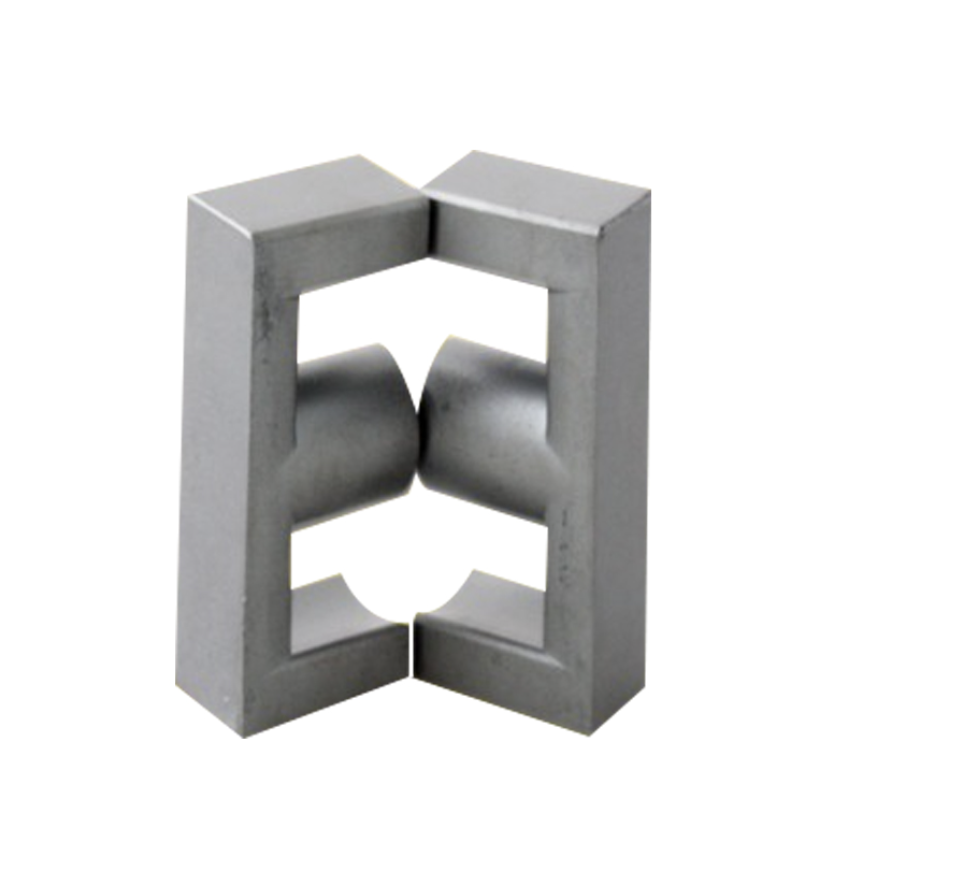
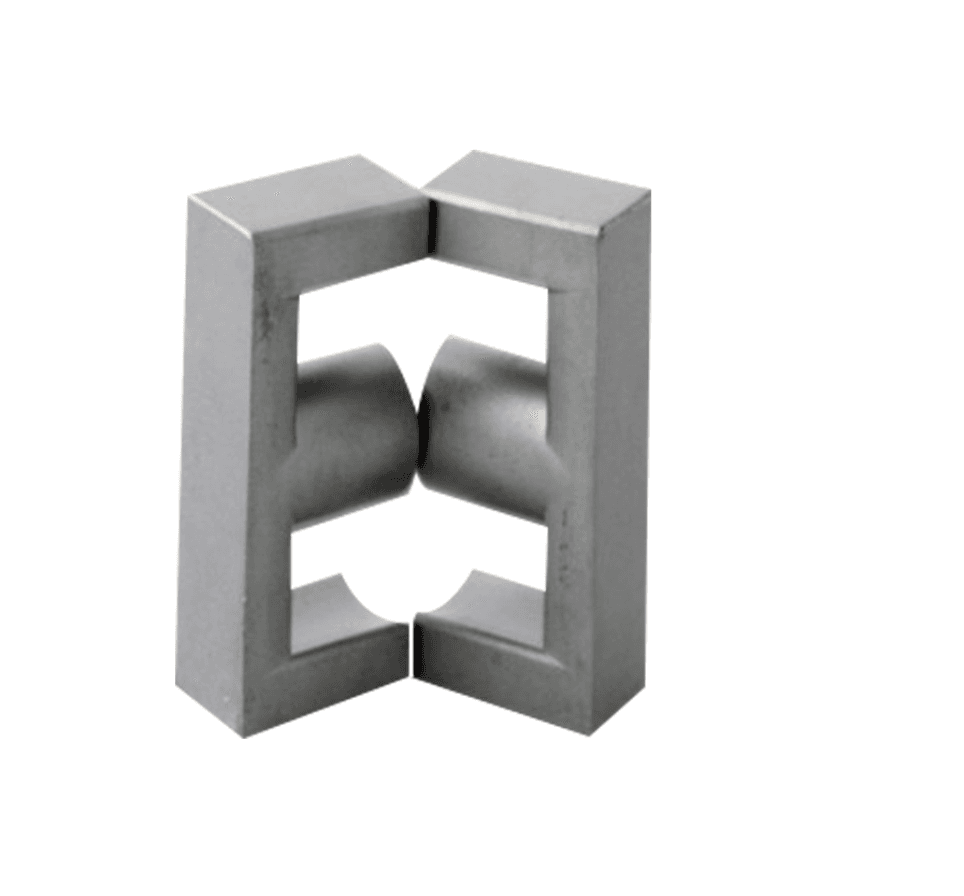
Storage requires an air gap. According to TI, storing energy efficiently in a small volume needs a small non-magnetic gap in series with the high-permeability core; virtually all of the magnetic energy is stored in that gap. [5] TDK draws the same line: gapped cores for flyback converters, generally ungapped cores for forward and push-pull converters. [4]
EE, ETD and toroid cores: how the circuit type affects the shape
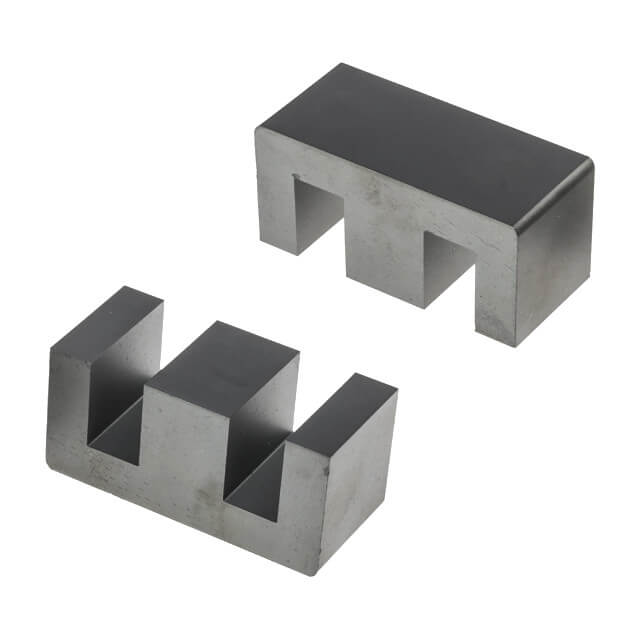
According to TI, ETD cores are E-E shapes too, with a large window area in relation to core size. [2] On a core with a discrete gap the winding should sit directly over the gap, that is, on the centre leg. [5] TDK recommends E and U cores for flyback converters, and E/ETD and RM/PM cores for forward and push-pull converters. [4]
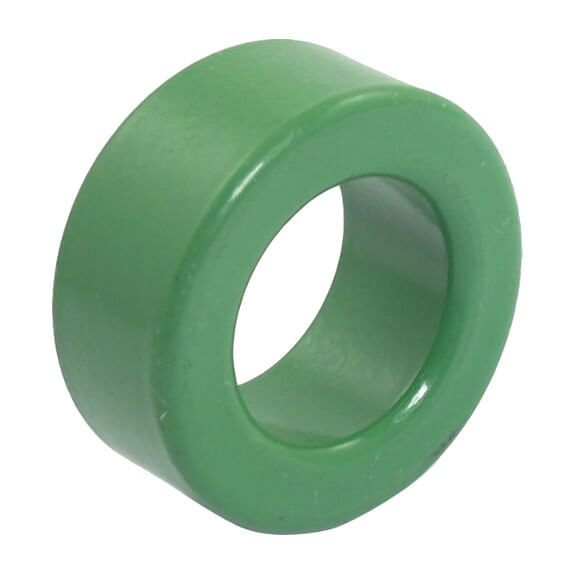
A toroid has very low leakage inductance and stray flux, but TI states that winding difficulty means toroids are seldom used in SMPS transformers. [2] A gapped ferrite toroid is a very bad choice for a flyback: windings distributed around the toroid do not conform to a discrete gap. [5] According to TDK, ring cores from R 13.3 to R 26 are used as chokes in the power lines of switch-mode power supplies. [4]
The Artek catalog lists EE ferrite cores (for example EE 25 / 13 / 7 - CF139), ETD ferrite cores (for example ETD 39 / 20 / 13- CF139) and ferrite toroids (for example T 25 / 15 / 10 - CF199). For choosing a shape, see the EE core and ETD core guides.
Asking Artek about a core for an SMPS transformer
- Circuit type: flyback, forward, push-pull, half-bridge or full-bridge.
- Switching frequency, input and output voltages, output power.
- Core shape and size; whether an air gap is needed and, if known, the AL value.
- Whether a bobbin is needed, a photograph of the existing part and the quantity.
Browse ferrite cores in the catalog or send Artek your request with these details.
Frequently asked questions
What is an SMPS transformer?
It is the ferrite-core transformer that steps the high-frequency AC voltage created by the switch up or down and isolates the input from the output. With secondaries of different turn counts it also provides several output voltages. [1] [2]
Does every SMPS contain a transformer?
No. In non-isolated circuits such as the buck and boost converters the magnetic component is only an inductor; flyback, forward, push-pull and bridge converters contain a transformer. [1] [2]
Why does a flyback transformer have an air gap?
Because a flyback transformer is really a coupled inductor that stores energy, and virtually all of the magnetic energy is stored in the non-magnetic gap in series with the core. A forward transformer is not meant to store energy, so its core is generally used ungapped. [4] [5]
Technical sources
- [1] onsemi: Switch-Mode Power Supply Reference Manual (SMPSRM/D).
- [2] Texas Instruments: Power transformer design (Magnetics Design, section 4).
- [3] Texas Instruments: Magnetic core characteristics (Magnetics Design, section 2).
- [4] TDK: Ferrites and accessories, application notes.
- [5] Texas Instruments: Inductor and flyback transformer design (Magnetics Design, section 5).